
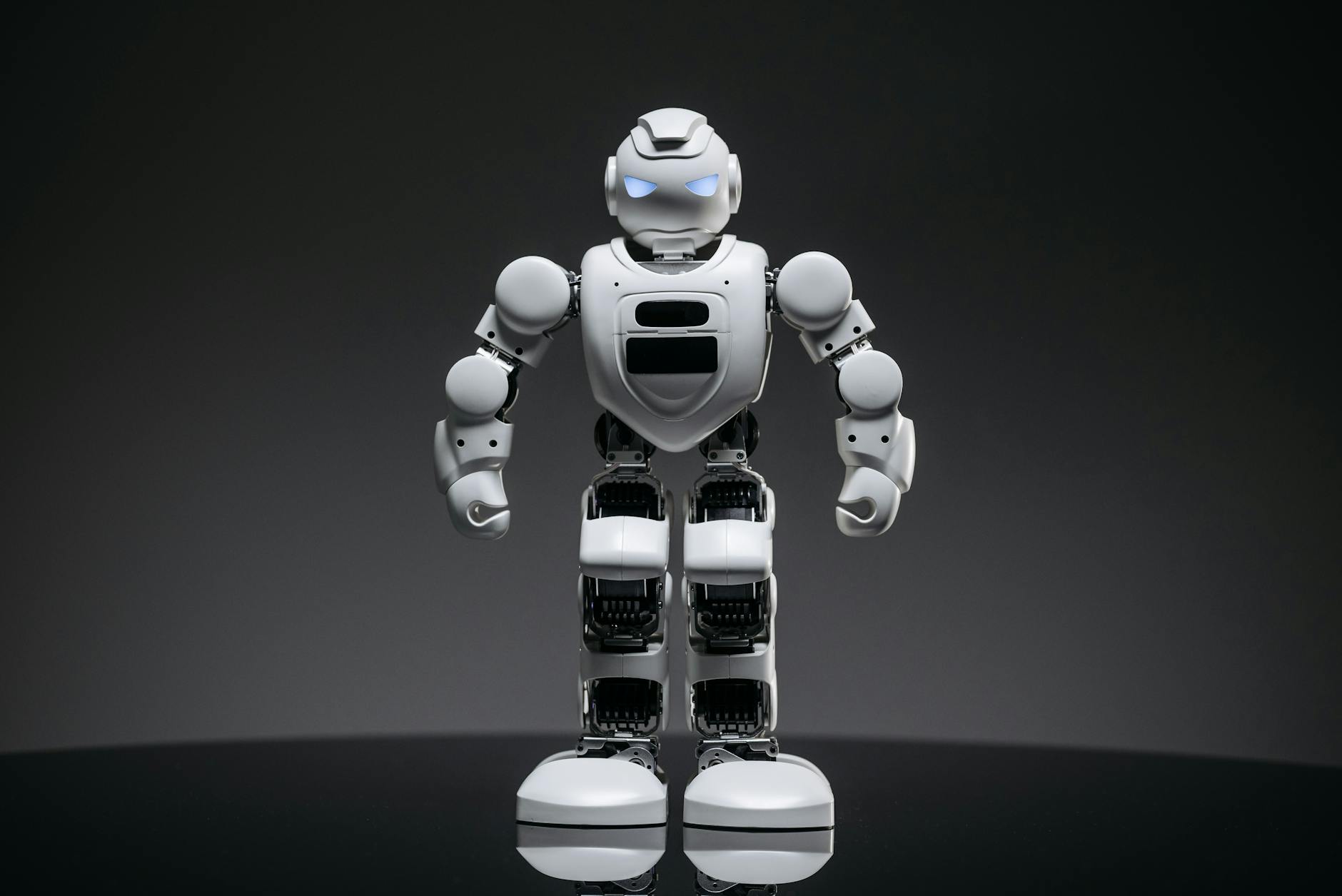
What Are Humanoid Robots? History, Design, Capabilities, Applications & Future
Humanoid robots—machines shaped like humans—have moved from science-fiction dreams into labs, factories, hospitals, and even shopping malls. They’re not just “robots that look human”; they’re complex systems combining mechanics, electronics, sensing, and artificial intelligence to perform tasks in environments built for people. This longform guide walks through what humanoid robots are, how they’re built, what they can (and can’t) do today, ethical and societal implications, real-world uses, and where the field is heading
Humanoid robot — a robot with a body shape and/or motion capabilities that resemble a human: two legs, a torso, two arms, a head, and a set of sensors and actuators that let it perceive, move, and interact in human environments. Some humanoid robots are full-sized and bipedal; others are partial (robotic arms on human-like torsos) or stylized (cartoonish faces for social interaction).
1. Brief history and milestones
- Early automata (ancient to 18th century): Mechanical figures that could move, sing, or write—precursors in form only.
- 20th century robotics: Industrial manipulators emerged (non-humanoid), while researchers pursued human-like machines as technical challenges.
- Late 20th / early 21st century: Advances in sensors, motors, control theory, and computing enabled practical humanoids. Iconic milestones include (among others): Honda’s ASIMO (demonstrated walking, stairs), Boston Dynamics’ Atlas (dynamic bipedal locomotion, parkour-style agility), and social humanoids like SoftBank/ALDEBARAN’s Pepper and Hanson Robotics’ Sophia.
- Today: Research and commercial humanoids co-exist—some prioritize mobility and manipulation; others prioritize social interaction and human-robot communication.
2. Why build humanoid robots? (Motivations)
- Operate in human environments: Human spaces—doors, stairs, tools, controls—are designed for two-armed, upright bipeds. Humanoid form factors can use existing infrastructure without redesign.
- Human-robot interaction (HRI): People intuitively interact with human-shaped agents; social cues, gestures, and facial expressions are familiar channels for communication.
- Research platform: Humanoids are excellent testbeds for control, perception, locomotion, and learning algorithms that generalize across tasks.
- Versatility: Two arms and bipedal mobility give a robot flexibility to perform many tasks—from carrying objects to operating tools—unlike specialized robots (e.g., floor scrubbers or robot arms).
3. Core components of a humanoid robot
A humanoid is an integrated system. Key subsystems:
3.1 Mechanical structure & actuators
- Skeleton & joints: Rigid links and joints (shoulders, elbows, hips, knees, ankles) give humanlike degrees of freedom (DoF).
- Actuators: Electric motors, brushless DC motors, series elastic actuators (SEA), hydraulic actuators (used by Boston Dynamics), or pneumatic muscles. Choice impacts strength, compliance, speed, and energy consumption.
- End effectors: Hands (multi-fingered dexterous hands), grippers, or tools.
3.2 Sensors
- Proprioceptive: Joint encoders (position), torque sensors, force/torque sensors—tell the robot about its own body state.
- Exteroceptive: Cameras (RGB), depth sensors (LiDAR, stereo, time-of-flight), microphones, tactile/pressure sensors on skin or fingertips, IMUs (inertial measurement units) for balance.
- Environmental: Temperature, gas, or proximity sensors for context-aware behavior.
3.3 Power and energy
- Batteries (Lithium-ion most common) or tethered power for research. Energy density is a limiting factor for autonomous operation.
3.4 Control systems & software
- Low level: Motor controllers, real-time joint control, balance controllers (e.g., zero-moment point (ZMP) methods).
- Mid level: Motion planning, whole-body control, grasp planning, compliance control.
- High level: Task planning, perception pipelines (object recognition, SLAM), natural language understanding, decision-making frameworks.
- Middleware / frameworks: ROS (Robot Operating System) is widely used to integrate sensors, control, and planning modules.
3.5 Artificial intelligence
- Perception: Computer vision for object detection, semantic understanding of scenes.
- Learning: Reinforcement learning (RL) for locomotion and manipulation, imitation learning from human demonstrations, supervised learning for perception tasks.
- Reasoning & language: NLP modules for instructions, dialogue systems for social robots.
4. Locomotion and balance: the hardest hardware/software problem
Walking on two legs is deceptively difficult. Challenges:
- Balance: Human bipedalism requires continuous feedback control—reacting to pushes, uneven terrain, and dynamic tasks.
- Dynamic gait: Efficient walking and running use momentum and compliant joints; replicating this requires precise timing and actuation.
- Energy efficiency: Bipedal walking is relatively inefficient for robots unless passive dynamics are exploited.
- Robustness: Recovery strategies for trips, slips, and collisions.
Approaches include:
- ZMP control (quasi-static), model predictive control, whole-body inverse dynamics, and learning-based policies (deep RL) trained in simulation then transferred to hardware.
5. Manipulation and dexterity
A humanoid’s hands and arms enable interaction with objects. Dexterity involves:
- Multi-fingered hands with sensors for grasp stability.
- Tactile feedback for delicate tasks (button pressing, handling fragile items).
- Force control and compliance to avoid damage and adapt to variations.
- Task learning: From simple pick-and-place to complex tool use, achieved through planning or learning.
Hands remain a major engineering bottleneck—human hands are extraordinarily capable, and robotic counterparts still lag in skill and reliability.
6. Perception and cognition
Humanoids must perceive complex, dynamic human environments:
- Scene understanding: Semantic segmentation, object detection, and spatial reasoning.
- Human understanding: Pose estimation, intent prediction, emotion/speech recognition for smooth HRI.
- SLAM (Simultaneous Localization and Mapping): For navigation in unknown or changing environments.
- Contextual reasoning: Choosing appropriate actions given social norms (e.g., personal space).
Integration of these capabilities into real-time, robust policies is an active research area.
7. Human-Robot Interaction (HRI) & social design
When robots are humanoid, design must account for:
- Appearance and expectations: Uncanny valley effects—too humanlike but imperfect results discomfort humans. Stylized or clearly robotic faces sometimes perform better socially.
- Gesture and proxemics: Using body language and maintaining comfortable distances.
- Voice & dialogue: Explicit instructions, natural conversation, and multi-modal communication (speech + gestures).
- Safety & trust: Transparent behavior, predictable reactions, and safeguards to reassure users.
Social humanoids are deployed as receptionists, companions, and educational tools, where perceived empathy and expressiveness matter.
8. Applications and use cases
8.1 Research & development
Humanoids serve labs to explore locomotion, manipulation, learning, and embodied cognition.
8.2 Industrial & logistics
In warehouses or factories, humanoid form can adapt to human tools and spaces, though wheeled or fixed robots remain more common for efficiency.
8.3 Healthcare & eldercare
Assistance with mobility, medication reminders, companionship, and telepresence. Social robots can reduce loneliness, but clinical efficacy varies.
8.4 Service & hospitality
Reception, information kiosks, guided tours—humanoids can interact comfortably with people.
8.5 Search & rescue / hazardous sites
Bipedal robots can traverse rubble, stairs, and uneven terrain where wheeled robots cannot (experimental deployments exist).
8.6 Education & entertainment
Teaching coding, demonstrating robotics principles, or performing in media and theme parks.
8.7 Military & law enforcement (controversial)
Potential use for logistics and reconnaissance; ethical and legal concerns limit weaponization of humanoids.
9. Major technical challenges (current limits)
- Battery life & power density: Limits autonomy and payload capacity.
- Robust, generalizable locomotion: Walking on uneven terrain, stairs, and recovering from disturbances reliably.
- Dexterous manipulation: Reliable, adaptable, and safe hands remain hard.
- Perception in clutter: Real-world variability—lighting, occlusion, dynamic humans—makes perception brittle.
- Real-time whole-body control: Coordinating many DOFs with safety and efficiency.
- Cost & manufacturability: Advanced humanoids require expensive hardware and custom parts—hard to scale commercially.
- Regulatory, safety, and social acceptance: Standards for interaction, liability, and physical safety.
10. Ethics, safety, and societal impact
Humanoid robots raise complex ethical questions:
- Job displacement vs augmentation: Will humanoids replace human roles (caregivers, receptionists) or augment them? History suggests automation changes jobs, but societal impacts depend on policy and retraining.
- Privacy & surveillance: Humanoids with cameras and mics in public/private spaces raise privacy concerns.
- Autonomy & responsibility: Determining liability in accidents—manufacturer, operator, or AI—remains unresolved legally.
- Deception & manipulation: Humanlike robots could be used to manipulate (fraud, persuasion); design ethics call for transparency.
- Access & equity: Who benefits from humanoid technology—wealthy institutions or broad society?
Safety frameworks and standards (ISO robotics standards, functional safety—ISO 13849, IEC 61508 concepts) are increasingly applied, but social governance lags technical progress.
11. Leading companies and research groups (representative, not exhaustive)
- Boston Dynamics: Known for dynamic bipedal robots (Atlas) and quadrupeds (Spot).
- Honda / ASIMO: Historic work on humanoid mobility research.
- SoftBank Robotics / Aldebaran: Pepper (social humanoid) and NAO (education/research).
- Hanson Robotics: Focus on expressive humanlike faces (e.g., Sophia).
- Toyota Research Institute, Intel, MIT, Carnegie Mellon, ETH Zurich, University of Tokyo, NASA: Major academic and institutional players in locomotion and manipulation.
- Emerging startups: Many focus on modular humanoid components, manipulation, or service roles.
12. Economics & market outlook
Humanoid robots today are mostly research platforms or limited-scale service deployments. Commercial scaling faces high R&D costs and niche markets. Market growth depends on:
- Improvements in cost, reliability, and battery technology.
- Clear commercial applications (e.g., eldercare, hospitality).
- Regulatory frameworks and public acceptance.
If these converge, humanoid adoption could accelerate in the 2030s for specific sectors.
13. The near future: what to expect
- Improved bipedal agility: Better controllers and learning methods will enable more robust walking and recovery.
- Simulation-to-real learning: Training locomotion and manipulation policies in simulation and transferring them to hardware at scale.
- Hybrid form factors: Robots combining humanoid arms with wheeled bases for energy efficiency in commercial settings.
- More capable hands: Increased dexterity using soft robotics and improved tactile sensors.
- Human-centric collaboration: Robots assisting rather than replacing humans in workplaces and homes, with safe physical interaction.
14. The long view: philosophical & cultural implications
Humanoid robots force us to ask fundamental questions about what it means to be human: agency, empathy, labor, and social roles. The design choices we make—from appearance to behavior—will shape social norms and legal frameworks for decades.
15. Practical considerations for organizations thinking about humanoids
- Define clear ROI: Pilot tasks where humanoid morphology is essential (stairs, human tools).
- Start with simulation: Validate policies before hardware testing.
- Safety first: Physical safety, data privacy, and transparent user interfaces.
- Human workflows: Design systems that augment human workers, not simply replace them.
- Partnerships: Collaborate with research labs for state-of-the-art algorithms and compliance guidance.
Conclusion
Humanoid robots combine one of engineering’s most ambitious designs—replicating human form and function—with cutting-edge AI, control theory, and materials science. They promise unique advantages for operating in human environments and enabling new human-robot collaborations, but they also confront deep technical, ethical, and economic challenges. The field advances steadily: expect humanoids to move from lab curiosities toward increasingly useful partners in workplaces and public spaces across the next decade—if technical hurdles, costs, and social questions are responsibly addressed.
FAQs
1. Are humanoid robots like humans?
No. Humanoid robots mimic human shape and certain motions, but cognition, dexterity, and perception remain far below human levels. They excel at narrow tasks, not general intelligence.
2. Why not just use wheeled robots?
Wheeled robots are more energy efficient and simpler, but they can’t climb stairs, use ladders, or operate tools designed for human hands—scenarios where humanoids are advantageous.
3. Are humanoid robots safe around people?
Designs incorporate safety (compliant actuators, force limits, vision systems), but ensuring robust, fail-safe interaction in all conditions is still an active area of research and regulation.
4. How long will humanoids take to be common in homes?
Widespread consumer humanoids are unlikely in the very near term. Expect targeted deployments (care facilities, hospitality) before mass consumer adoption—possibly decades depending on progress.
5. What powers humanoid robots?
Primarily rechargeable batteries today. Tethered power is used in labs. Advances in battery energy density and power management are critical for autonomy.
6. Can humanoid robots learn new tasks by watching humans?
Yes—imitation learning and demonstration-based learning are active research approaches. Transfer from human demonstration to robot execution is non-trivial but progressing.
7. Do humanoid robots feel emotions?
No—robots do not have subjective experience. They can simulate emotional expressions (for social interaction), but these are programmed or learned behaviors, not feelings.
8. What are the biggest technical bottlenecks now?
Energy/power density, dexterous hands, robust perception in complex environments, and safe, generalizable locomotion.
9. Could humanoids be used in dangerous jobs?
Yes—search & rescue, radioactive cleanup, offshore inspections are potential use cases where humans face high risk.
10. How should society prepare for humanoids?
Invest in education and retraining, set safety and privacy standards, promote ethical design, and ensure equitable access to benefits from automation.


